
Adobe Creative Cloud USA Pricing 2026: $300/Year – Save $540 vs Adobe
March 23, 2026
Marketing Agency Software Stack USA 2026: $700/Year vs $2,640 – Complete Setup
March 25, 2026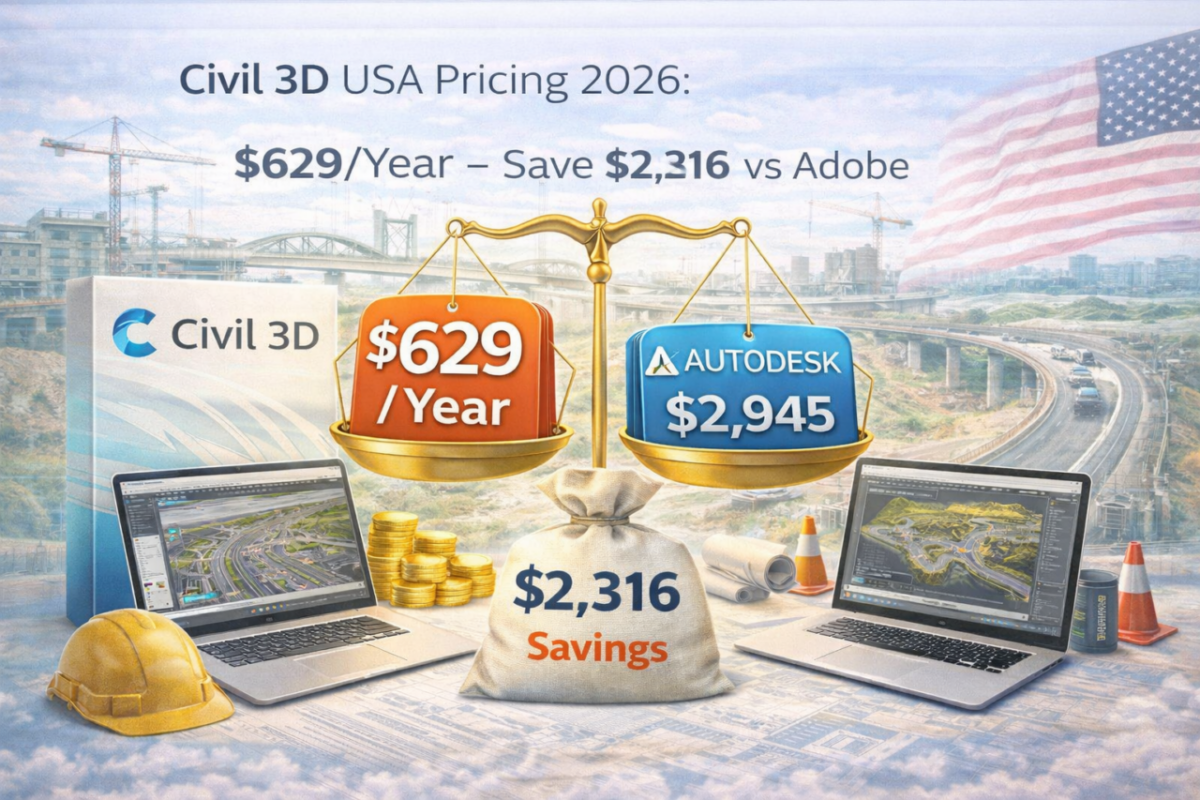
Civil 3D remains one of the most important Autodesk tools for infrastructure, site development, grading, utilities, and transportation design in the United States. It is widely used by civil engineering consultancies, land development firms, and transportation teams working on roads, subdivisions, and municipal systems.
The problem is cost. Autodesk’s official Civil 3D pricing in the USA sits at around $2,945 per year per user, which becomes a serious burden for small engineering firms and regional consultancies trying to scale responsibly.
That is why commercial Civil 3D pricing at around $629 per year stands out so clearly. For firms with several users, the difference is large enough to materially affect equipment budgets, training, hiring plans, and project margins.
Civil 3D USA Pricing Overview
Autodesk Official: $2,945/year
Commercial License: $629/year
Estimated Savings: $2,316/year
View Civil 3D Commercial Offer →Official Civil 3D Pricing in the USA
Autodesk offers Civil 3D through monthly, annual, and multi-year subscription structures. As with other Autodesk products, the monthly option is the least efficient over time, while the annual plan is the real benchmark for firms comparing long-term software costs.
- Monthly: $275/month, or $3,300/year if paid monthly
- Annual: $2,945/year
- 3-Year: $8,550 total, averaging about $2,850/year
For a regional civil consultancy with several engineers, this cost escalates quickly. Even a five-user setup at official Autodesk pricing pushes the annual Civil 3D software budget well above $14,000.
That is exactly why Civil 3D pricing deserves serious attention from small and mid-size engineering firms.
What Civil 3D Commercial Includes
Civil 3D is not just AutoCAD with a few extra tools. It is a specialized civil infrastructure environment built for terrain, alignments, corridors, utilities, grading, and production documentation.
Typical Civil 3D commercial workflow includes:
- Corridor design for roads and linear infrastructure
- Surface modeling and grading workflows
- Alignments, profiles, and cross-sections
- Pipe networks for storm, sanitary, and water systems
- Earthwork and quantity takeoffs
- AutoCAD integration and sheet production
- Autodesk account activation, updates, and subscription workflow
For civil engineering teams, these are not “nice extras.” They are the core tools that support real project delivery.
Civil 3D vs AutoCAD
AutoCAD remains useful for general drafting, markup, and multidisciplinary CAD work. However, the moment a workflow depends on grading, corridor modeling, utility networks, or profile production, Civil 3D becomes the proper tool rather than just the more expensive one.
That distinction matters because many firms still compare Civil 3D against AutoCAD as if they solved the same problem. They do not. AutoCAD is broader and more generic. Civil 3D is purpose-built for infrastructure and civil design workflows.
If a firm spends real time on roads, subdivisions, drainage, site grading, or municipal utility design, Civil 3D usually justifies itself immediately.
When Civil 3D Makes the Most Sense
Civil 3D is especially valuable for firms working on transportation, land development, drainage, or utility-heavy design. It becomes difficult to replace once project teams depend on surface modeling, earthwork calculations, or corridor production.
- Civil engineering consultancies
- Transportation design firms
- Site development and subdivision planning teams
- Municipal engineering offices
- Infrastructure consultants handling grading and utility networks
- Firms producing plan sets from model-based civil workflows
For these teams, the software is not just a drafting platform. It is part of the engineering production backbone.
When AutoCAD Alone May Still Be Enough
Not every firm needs Civil 3D. If a team works mainly on general 2D drafting, annotations, simple site layouts, or multidisciplinary CAD tasks without true civil modeling, then AutoCAD may remain sufficient.
This is especially true for firms that touch infrastructure only occasionally or outsource the more specialized civil design work.
The right question is not whether Civil 3D is better in general, but whether the project mix genuinely requires its civil-specific workflows.
Real Team Savings
Autodesk direct pricing: $14,725/year (5 users)
Commercial pricing: $3,145/year
Total annual savings: $11,580
For a five-engineer team, this is not a marginal saving. It can fund survey equipment, workstations, software training, drone workflows, or business development efforts that actually strengthen the firm.
Over several years, the cumulative difference becomes large enough to change how a small consultancy invests in growth.
Civil 3D vs Bentley OpenRoads
In the US infrastructure market, Bentley OpenRoads remains a real competitor, especially in DOT environments and legacy Bentley workflows. However, Civil 3D keeps a strong position thanks to Autodesk ecosystem familiarity, AutoCAD integration, and wider accessibility for many firms.
For consultancies working across different clients and project types, Civil 3D often benefits from lower adoption friction, stronger DWG familiarity, and easier staffing because the Autodesk user base is broad.
That makes Civil 3D especially attractive for firms that need practical deployment and wide compatibility rather than a purely agency-specific standard.
Surface Modeling and Site Workflows
One of Civil 3D’s strongest advantages is the way it handles surfaces, grading, and earthwork. For many firms, this eliminates the need for separate terrain-focused software for everyday project work.
When the workflow includes cut-and-fill calculations, grading studies, drainage assumptions, and terrain updates, Civil 3D delivers far more than general CAD software can.
That matters because site and surface workflows are often where time savings become most visible in real project delivery.
Deployment and Daily Use
Civil 3D commercial subscriptions are typically deployed through Autodesk account-based licensing. Engineers sign in, install the software, and continue working inside a familiar Autodesk environment with standard update delivery and account-based access.
For firms, what matters most is continuity. Templates, alignments, surfaces, plan production standards, and consultant file exchange all need to remain stable from one project to the next.
That operational continuity is part of why Civil 3D remains difficult to replace once it becomes embedded in the workflow.
Build a smarter civil engineering software stack
If your firm relies on grading, corridors, utilities, and surface-based workflows, Civil 3D is often the right core platform. The key is paying for it intelligently and only expanding into broader Autodesk bundles when the workflow truly demands it.