How SketchUp Pro Accelerates Architecture Design at $299/Year (USA 2026)
April 20, 2026
How Singapore Architecture Firms Can Reduce BIM Software Costs by 70% in 2026
April 24, 2026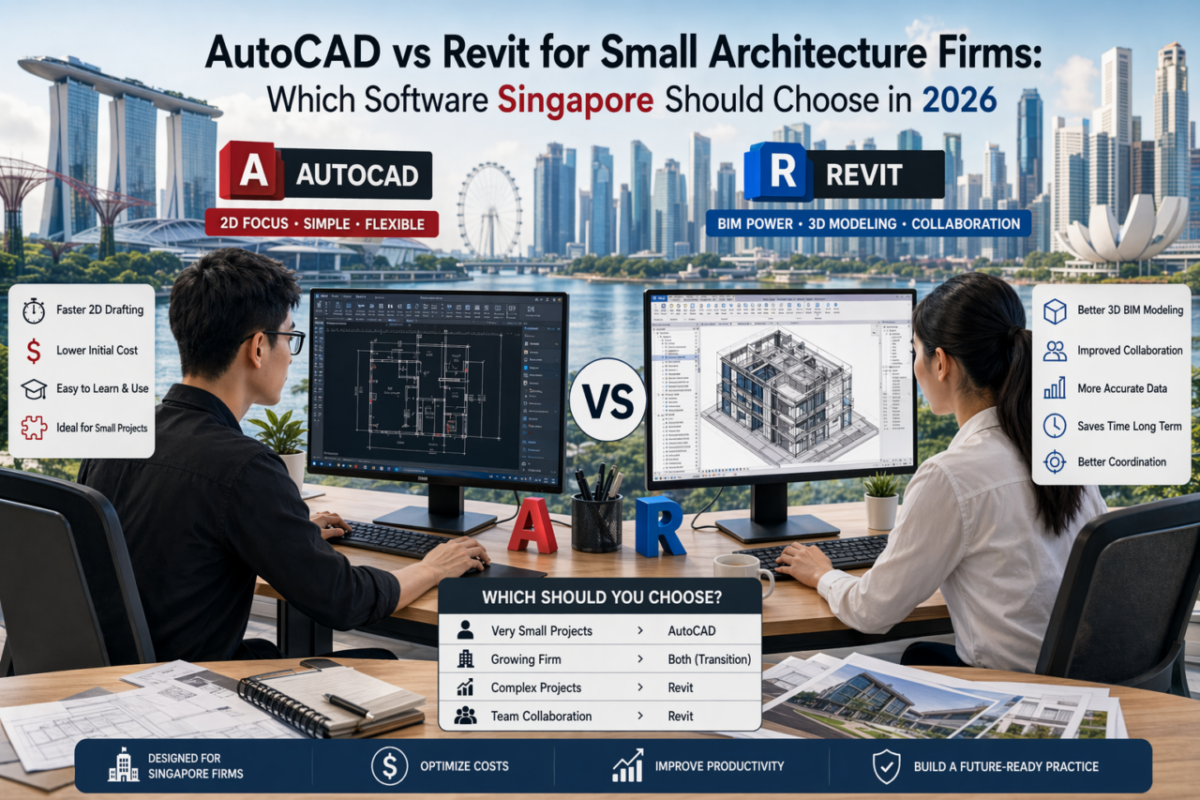
Small architecture firms in Singapore (2-8 employees) face a strategic software decision that impacts both regulatory compliance and operational budgets. CORENET X’s 2026 BIM mandate pushes firms toward Revit, yet many practices built their workflows around AutoCAD’s 2D drafting efficiency over decades.
The question isn’t AutoCAD OR Revit—it’s understanding when each tool delivers value, how they complement each other, and whether small Singapore firms can afford both without sacrificing profitability.
This guide explains which software Singapore architecture practices actually need, real transition strategies from AutoCAD-only workflows to BIM-ready operations, and commercial licensing that makes dual-software setups financially viable.
The small firm software dilemma
What 5-person Singapore architecture practice actually pays annually:
AutoCAD-only approach:
5 AutoCAD licenses → SGD 14,025/year official
Outsource BIM modeling → SGD 15,000-25,000/year
Revit-only approach:
5 Revit licenses → SGD 22,205/year official
Learning curve productivity loss → SGD 8,000-12,000
What AutoCAD still does better in 2026
AutoCAD remains the superior tool for specific architectural workflows Singapore firms encounter regularly:
Conservation and renovation projects. Singapore’s shophouse districts (Chinatown, Kampong Glam, Tiong Bahru) require measured surveys and existing condition documentation. AutoCAD handles imported laser scan data, PDF underlays from URA archives, and hand-measured sketches more efficiently than Revit. When original drawings don’t exist or exist only as physical prints, AutoCAD’s 2D precision excels.
Schematic design iterations. Early design phases benefit from AutoCAD’s speed. Sketch bubble diagrams, test multiple site layouts, explore facade concepts—AutoCAD’s geometry-based approach allows faster iteration than Revit’s component-based modeling. Small firms doing 10-15 quick feasibility studies monthly find AutoCAD more responsive.
Coordination with consultants stuck on AutoCAD. Many Singapore structural engineers, M&E consultants, and contractors still deliver DWG files. AutoCAD native compatibility eliminates conversion issues Revit sometimes introduces when importing/exporting DWG formats.
AutoCAD advantages:
✔ Fast 2D drafting and schematic design
✔ Renovation and existing building documentation
✔ Lower learning curve for junior staff
✔ Smaller file sizes, faster performance
✔ DWG compatibility with legacy projects
Why Revit becomes non-negotiable for Singapore firms
CORENET X submission requirements make BIM software increasingly mandatory, not optional. While URA and BCA accept AutoCAD submissions for small projects currently, the regulatory direction points clearly toward BIM-only approvals within 2-3 years.
Projects requiring Revit in Singapore 2026:
New commercial developments. Office buildings, retail complexes, mixed-use projects above 5,000 sqm GFA require BIM coordination. Developers expect Revit models for contractor tendering. Main contractors increasingly refuse non-BIM documentation, knowing clash detection and coordination save construction costs.
Government and institutional projects. HDB, JTC, government ministries mandate BIM submissions. Small firms pursuing government tenders without Revit capability lose competitive opportunities representing 20-30% of Singapore’s architectural work.
Multi-disciplinary coordination. Projects involving structural, M&E, landscape, and interior design disciplines benefit from Revit’s parametric coordination. When facade changes affect structural loads, MEP routing, and interior ceiling heights, Revit updates all disciplines simultaneously—AutoCAD requires manual coordination across separate DWG files.
Revit advantages:
✔ CORENET X BIM submission compliance
✔ Automatic coordination across disciplines
✔ Parametric design changes propagate automatically
✔ Government tender competitiveness
Real transition strategy: 5-person Singapore firm
Consider a boutique practice in River Valley specializing in residential landed houses and small commercial fit-outs. Current setup: AutoCAD-only, 12 years operation, 8-10 projects annually.
Year 1 transition approach (gradual adoption):
Maintain AutoCAD for all staff. Continue using AutoCAD for schematic design, existing building surveys, and renovation projects. Don’t disrupt working production workflows unnecessarily.
Add 2 Revit licenses strategically. Purchase Revit for practice’s 2 senior architects. They tackle new commercial projects requiring BIM, while junior staff continue AutoCAD work on residential landed houses not requiring full BIM coordination.
Hybrid workflow emerges naturally. Senior architects model new projects in Revit, export DWG views for junior staff to annotate and detail in AutoCAD. This leverages AutoCAD’s 2D annotation efficiency while building Revit proficiency gradually.
Year 2-3: Full team capability. As junior staff gain experience, they rotate onto Revit projects. Eventually all 5 staff members use both tools depending on project requirements—AutoCAD for renovations/feasibility studies, Revit for new builds and BIM-mandatory submissions.
Commercial licensing makes dual-software affordable
Official Autodesk pricing makes maintaining both AutoCAD AND Revit licenses financially challenging for small firms. Combined annual costs exceed SGD 36,000 for 5-person practice—13-15% of typical small firm revenue.
Commercial licensing comparison (5 seats, SGD):
Official AutoCAD + Revit → SGD 36,230/year
Commercial AutoCAD + Revit → SGD 8,760/year
Annual savings → SGD 27,470
Equivalent to: Junior architect annual salary OR office rent 8 months
Commercial licensing delivers identical software—same Autodesk applications, same file formats, same CORENET X compatibility. Procurement channel differs, pricing improves dramatically.
Which approach Singapore small firms should take
The optimal strategy depends on project mix and growth trajectory:
AutoCAD + outsourced BIM (Year 1-2): Firms doing primarily residential landed houses, renovations, or conservation work can maintain AutoCAD workflows and outsource occasional BIM requirements to specialized consultants. This delays Revit investment until project mix justifies it.
Hybrid AutoCAD + Revit (Year 2-4): Firms targeting commercial projects or government tenders need Revit capability. Start with 2-3 Revit licenses for senior staff, maintain AutoCAD for entire team. Gradually expand Revit adoption as proficiency grows.
Revit-primary workflow (Year 4+): Established firms with consistent commercial project pipeline eventually transition to Revit-first workflows, using AutoCAD only for specific tasks where it excels (existing building documentation, schematic design sketches).
Build complete Singapore architecture software stack
AutoCAD + Revit commercial licensing: SGD 1,752/year per seat. Both tools, full CORENET X compliance, half official cost.
Or get complete AEC Collection: