Adobe Illustrator Italia 2026: €293/Anno vs €91 – Guida Prezzi Graphic Designer
February 12, 2026
Adobe Creative Cloud USA 2026 Pricing: $300/Year vs $840 – Freelance Designers Save $540 Annually
March 11, 2026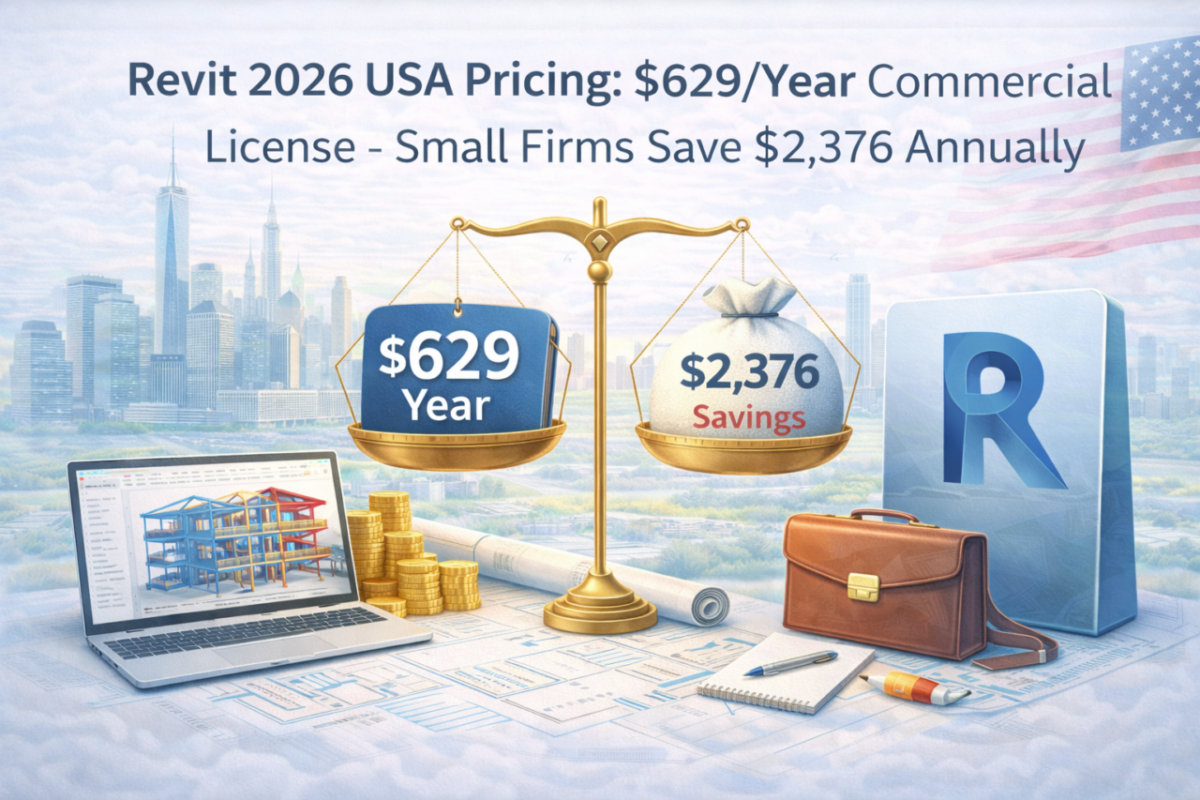
For small architecture firms in the United States, Revit is no longer optional in many project types. BIM expectations continue to grow, consultants increasingly exchange Revit files by default, and larger projects often assume a model-based workflow from the start.
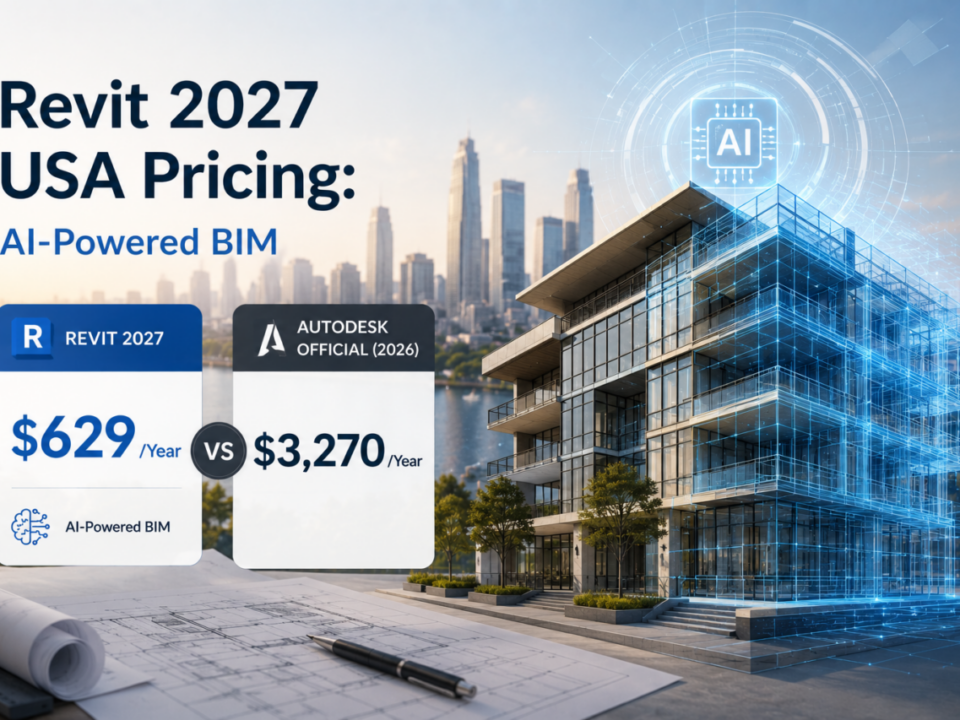
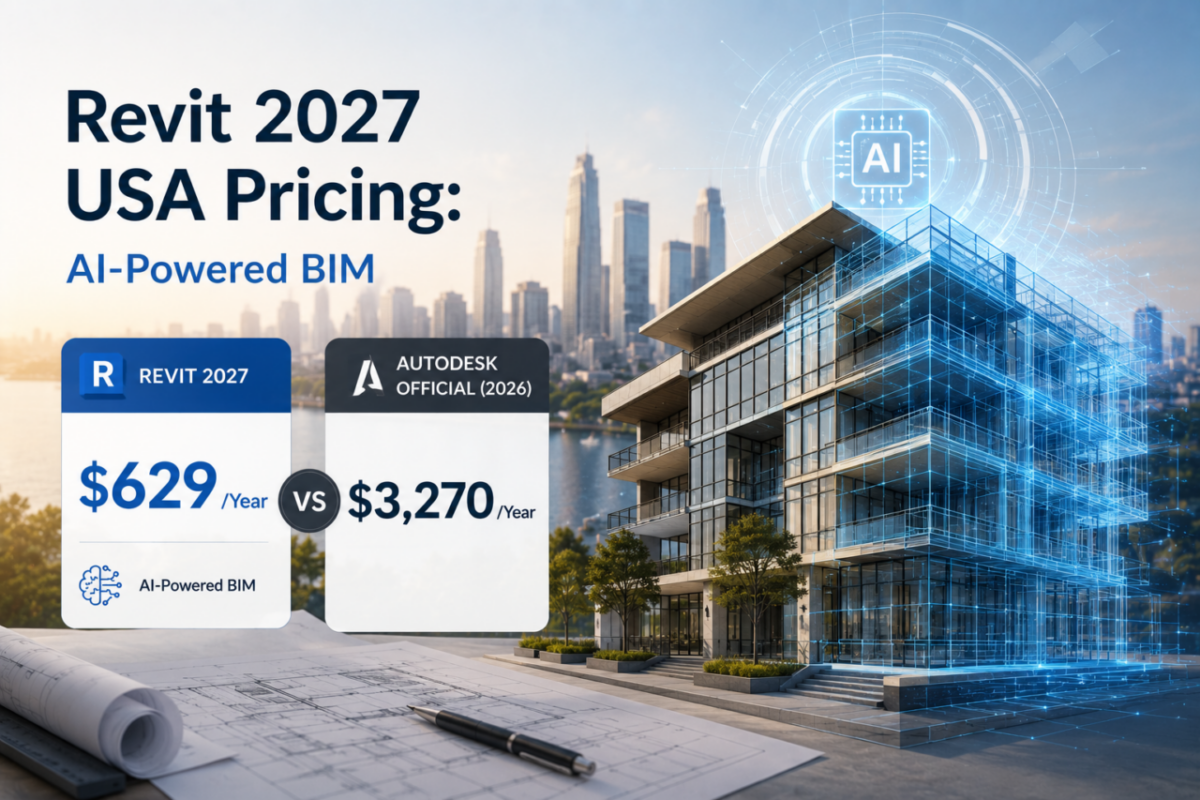
The real problem is cost. Autodesk’s official Revit pricing in the USA reaches about $3,005 per year per user, which becomes difficult to justify for firms with tight staffing and limited overhead flexibility.
That is why commercial Revit pricing at around $629 per year changes the conversation so dramatically. For small studios, the annual savings per license are large enough to affect hiring, marketing, rendering, and growth decisions.
Revit USA Pricing Overview
Autodesk Official: $3,005/year
Commercial License: $629/year
Estimated Savings: $2,376/year
View Revit Commercial Offer →Official Revit Pricing in the USA
Autodesk offers Revit through monthly, annual, and multi-year pricing. As with many Autodesk products, monthly billing is the least efficient route, while the annual subscription is the real point of comparison for firms budgeting software costs.
- Monthly: $380/month, or $4,560/year if paid monthly
- Annual: $3,005/year
- 3-Year: $9,020 total
For a five-person architecture studio, Autodesk’s direct annual pricing pushes the software budget above $15,000 per year. For a small firm, that is no longer a minor line item. It becomes a strategic expense.
This is exactly why understanding Revit USA pricing matters in real business terms, not just in software terms.
What Revit Commercial Includes
Revit remains the core BIM environment for many architecture, structure, and MEP workflows. Firms use it for model-based design, coordinated documentation, schedules, and consultant collaboration.
Typical Revit commercial workflow includes:
- Parametric BIM modeling
- Plans, sections, elevations, and schedules
- Dynamo-based visual programming
- API access for automation and extensions
- Rendering export to tools like Enscape or V-Ray
- Autodesk account-based activation and updates
For most architecture firms, these are the features that matter in daily production. The value of Revit is not theoretical. It is operational.
Revit vs AEC Collection
The AEC Collection becomes attractive when a firm needs several Autodesk tools beyond Revit. If the workflow regularly depends on AutoCAD, Civil 3D, Navisworks, InfraWorks, or 3ds Max, then the bundle often makes more sense than buying tools separately.
However, many small architecture studios do not actually need the full AEC stack every day. If the office mainly uses Revit and only touches other Autodesk tools occasionally, then standalone Revit can still be the more efficient purchase.
That is why the right choice depends on workflow depth, not on bundle size alone.
When Standalone Revit Is Usually Enough
For many firms with 2 to 10 people, standalone Revit is sufficient. This is especially true for architecture studios focused on residential, small commercial, or mixed-use projects where consultants handle structural and MEP production independently.
- Residential architecture practices
- Small commercial design firms
- Studios outsourcing structural or MEP work
- Offices using Revit as their central BIM tool
- Teams that do not need Civil 3D or Navisworks daily
In these cases, paying for the full AEC Collection may simply mean paying for tools that remain unused most of the year.
Why Revit Demand Keeps Growing in the USA
The push toward BIM is no longer limited to large firms or public megaprojects. Across the United States, more clients, consultants, and authorities expect model-based coordination as a normal part of professional delivery.
In practical terms, this means small firms without Revit capability can lose access to better projects, stronger consultant relationships, and more advanced building workflows.
So the software decision is not just about cost. It is also about staying competitive in a market that increasingly expects BIM maturity.
Small Firm Cost Example
Autodesk direct pricing: $15,025/year (5 users)
Commercial pricing: $3,145/year
Total annual savings: $11,880
For a five-person architecture studio, that difference is very real. It can cover rendering subscriptions, new workstations, team training, marketing, or simply improve financial breathing room.
Over several years, the savings become large enough to materially change how a small firm invests in growth.
Revit vs Revit LT and Other Alternatives
Some firms consider Revit LT, SketchUp, Archicad, or Chief Architect instead. In some cases, those tools are valid alternatives. However, Revit continues to dominate when interoperability, consultant coordination, and BIM-driven documentation matter.
That is particularly relevant in urban markets and in projects where file exchange with structural, MEP, or contractor teams is already centered around Autodesk workflows.
So while alternatives exist, Revit often remains the safest professional standard for firms that want to stay aligned with broader US project expectations.
Rendering and the Full BIM Stack
Revit alone is rarely the entire workflow anymore. Most firms combine it with a rendering solution to improve presentations and client approvals. Enscape is a common pairing because it adds real-time rendering without forcing a more complex visualization pipeline.
That is why software savings on Revit matter so much. A lower Revit cost leaves room to add complementary tools while still spending far less overall than Autodesk’s official direct pricing.
In practice, a firm can pair Revit with Enscape and still remain far below the cost of Autodesk’s official Revit subscription alone.
Deployment and Practical Use
Revit commercial subscriptions are typically activated through Autodesk account-based licensing. Users install the software, sign in, and work inside the standard Autodesk ecosystem with the expected update flow and subscription management model.
For firms, what matters most is stability, compatibility, and predictable deployment. Revit is not just a modeling tool. It is part of the documentation and delivery backbone of the office.
That is why getting the pricing right matters as much as choosing the software itself.
Build a smarter BIM stack
If your firm needs Revit as the core BIM platform, commercial pricing makes it far easier to justify. You can then add rendering or broader Autodesk tools only where they genuinely improve the workflow.