AEC Collection 2027 South Africa: Complete BIM Suite at ZAR 15,695/Year vs ZAR 78,475 Autodesk
May 30, 2026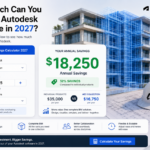
How Much Can You Save on Autodesk Software in 2027?
June 5, 2026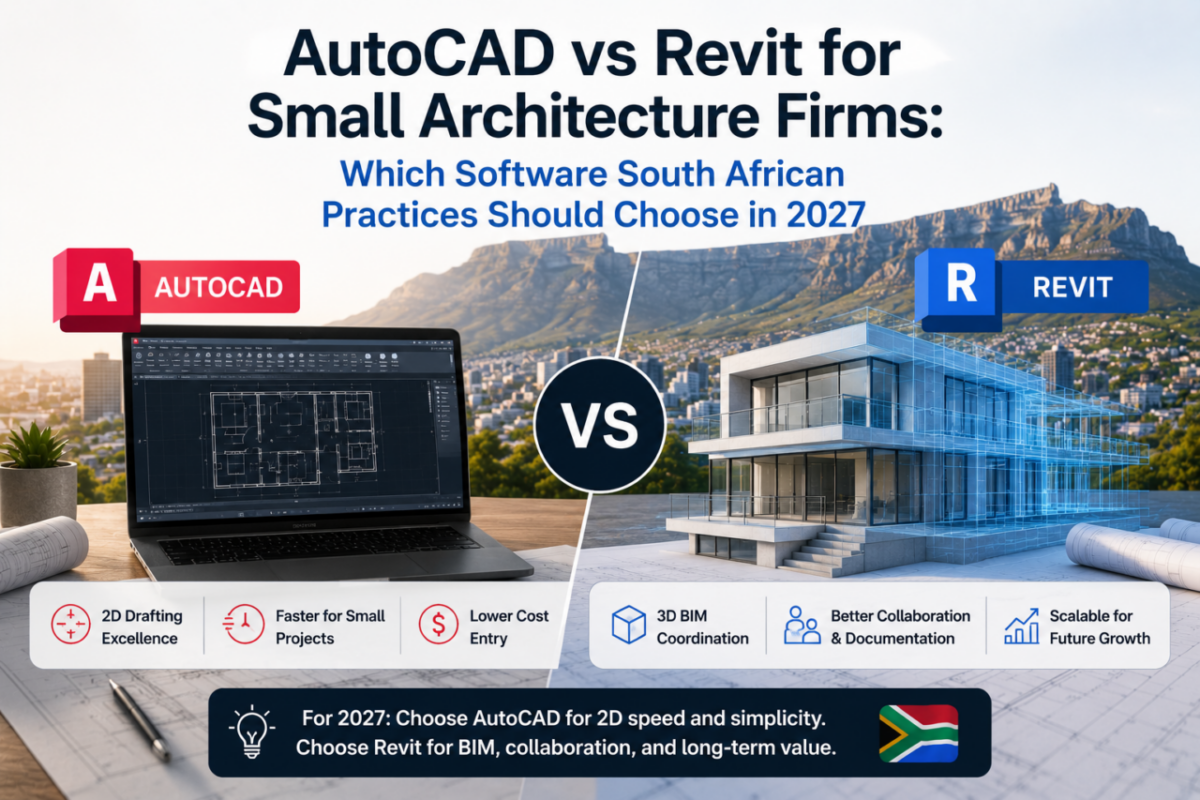
Small architecture firms across Johannesburg, Cape Town, and Durban (2-8 employees) face a critical software decision that impacts both Green Building Council compliance and operational budgets. GBCSA’s Green Star certification increasingly favors BIM workflows, pushing practices toward Revit, yet many small firms built their design processes around AutoCAD’s 2D drafting efficiency over decades of residential and commercial work.
The question isn’t AutoCAD OR Revit—it’s understanding when each tool delivers value for South African projects, how they complement each other across different building typologies, and whether small Sandton or Sea Point practices can afford both without sacrificing profitability in competitive tender environments.
This guide explains which software South African architecture practices actually need for municipal submissions, real transition strategies from AutoCAD-only workflows to BIM-ready operations, and commercial licensing that makes dual-software setups financially viable for firms competing across residential, commercial, and heritage conservation sectors.
The small firm software dilemma South Africa
What 5-person South African architecture practice actually pays annually:
AutoCAD-only approach:
5 AutoCAD licenses → ZAR 190,000/year official
Outsource BIM modeling → ZAR 220,000-340,000/year
Revit-only approach:
5 Revit licenses → ZAR 290,500/year official
Learning curve productivity loss → ZAR 115,000-160,000
What AutoCAD still does better in South African practice
AutoCAD remains the superior tool for specific architectural workflows that South African firms encounter regularly across residential, commercial, and heritage sectors:
Heritage conservation and alterations. Cape Town’s Bo-Kaap district, Johannesburg’s Maboneng Precinct, and Durban’s beachfront heritage buildings require measured surveys and existing condition documentation. AutoCAD handles imported laser scan data, PDF underlays from municipal archives, and hand-measured sketches more efficiently than Revit’s building-centric workflows. Moreover, when original drawings exist only as physical prints or outdated municipal records, AutoCAD’s 2D precision excels at creating accurate as-built documentation.
Schematic design iterations for developers. Early design phases benefit from AutoCAD’s speed when Sandton developers request multiple feasibility studies or Sea Point residential clients explore alternative site layouts. Sketch bubble diagrams, test parking configurations, explore facade concepts—AutoCAD’s geometry-based approach allows faster iteration than Revit’s component-based modeling. Consequently, small firms doing 12-18 quick feasibility studies monthly find AutoCAD more responsive for initial client presentations.
Coordination with consultants using legacy systems. Many South African structural engineers, M&E consultants, and quantity surveyors still deliver DWG files rather than BIM models. AutoCAD native compatibility eliminates conversion issues Revit sometimes introduces when importing/exporting DWG formats for municipal building plan submissions. As a result, coordination workflows remain smoother when external consultants haven’t yet adopted BIM processes.
AutoCAD advantages South Africa:
✔ Fast 2D drafting and schematic design iterations
✔ Heritage conservation and alterations documentation
✔ Lower learning curve for junior staff recruitment
✔ Smaller file sizes, faster performance on standard hardware
✔ DWG compatibility with legacy municipal archives
Why Revit becomes non-negotiable for South African firms
Green Building Council certification and municipal BIM adoption make Revit increasingly mandatory rather than optional. While Cape Town, Johannesburg, and eThekwini municipalities accept AutoCAD submissions for small residential projects currently, the regulatory direction points clearly toward BIM-required approvals within 2-3 years across major metros.
Projects requiring Revit in South Africa 2027:
Green Star certified developments. Commercial office buildings, retail centers, and residential estates pursuing GBCSA Green Star certification require BIM energy modeling and water efficiency analysis. Sandton developers expect Revit models for contractor tendering on sustainability-focused projects. Furthermore, main contractors increasingly refuse non-BIM documentation, knowing clash detection saves construction costs on complex multidisciplinary coordination.
Government and institutional projects. Department of Public Works, provincial education departments, and metropolitan municipalities increasingly mandate BIM submissions for new facilities. Small firms pursuing government tenders without Revit capability lose competitive opportunities representing 18-25% of South African architectural work across Gauteng, Western Cape, and KwaZulu-Natal provinces.
Multi-disciplinary coordination projects. Mixed-use developments involving architectural, structural, M&E, and fire engineering disciplines benefit from Revit’s parametric coordination. When facade changes affect structural loads, MEP routing, and interior ceiling heights, Revit updates all disciplines simultaneously—AutoCAD requires manual coordination across separate DWG files. Therefore, Waterfall mixed-use schemes and V&A Waterfront expansions demand BIM workflows for efficient consultant coordination.
Revit advantages South Africa:
✔ GBCSA Green Star submission compliance
✔ Automatic coordination across disciplines
✔ Parametric design changes propagate automatically
✔ Government tender competitiveness improvement
Real transition strategy: 5-person South African firm
Consider a boutique practice in Sea Point specializing in residential houses, small commercial fit-outs, and heritage alterations. Current setup: AutoCAD-only, 10 years operation, 9-12 projects annually across Western Cape.
Year 1 transition approach (gradual adoption):
Maintain AutoCAD for all staff. Continue using AutoCAD for schematic design, heritage building surveys, and residential alteration projects. Don’t disrupt working production workflows unnecessarily when clients aren’t requesting BIM deliverables for single-family houses or small retail fit-outs.
Add 2 Revit licenses strategically. Purchase Revit for practice’s 2 senior architects. They tackle new commercial projects requiring Green Star compliance or municipal BIM submissions, while junior staff continue AutoCAD work on residential houses not requiring full BIM coordination. Moreover, this staged approach minimizes training costs and productivity disruption during transition periods.
Hybrid workflow emerges naturally. Senior architects model new commercial projects in Revit, export DWG views for junior staff to annotate and detail in AutoCAD. This leverages AutoCAD’s 2D annotation efficiency while building Revit proficiency gradually across team members without overwhelming junior staff with simultaneous software transitions.
Year 2-3: Full team capability development. As junior staff gain experience through rotation onto Revit projects, eventually all 5 staff members use both tools depending on project requirements—AutoCAD for heritage alterations and residential feasibility studies, Revit for new commercial builds and Green Star submissions. Consequently, the practice gains competitive flexibility across diverse project typologies.
Commercial licensing makes dual-software affordable South Africa
Official Autodesk pricing makes maintaining both AutoCAD AND Revit licenses financially challenging for small South African firms. Combined annual costs exceed ZAR 480,500 for 5-person practice—representing 14-17% of typical small firm revenue across residential and small commercial sectors.
Commercial licensing comparison (5 seats, ZAR):
Official AutoCAD + Revit → ZAR 480,500/year
Commercial AutoCAD + Revit → ZAR 119,000/year
Annual savings → ZAR 361,500
Equivalent to: Two junior architect salaries OR office rent 9 months
Commercial licensing delivers identical software—same Autodesk applications, same file formats, same Green Building Council compatibility. Procurement channel differs, pricing improves dramatically for small practices competing across Johannesburg, Cape Town, and Durban markets.
Which approach South African small firms should take
The optimal strategy depends on project mix and growth trajectory across different South African building sectors:
AutoCAD + outsourced BIM (Year 1-2): Firms doing primarily residential houses, heritage alterations, or small retail fit-outs can maintain AutoCAD workflows and outsource occasional BIM requirements to specialized consultants. This delays Revit investment until commercial project mix justifies internal capability development.
Hybrid AutoCAD + Revit (Year 2-4): Firms targeting commercial developments or government tenders need Revit capability for Green Star submissions and municipal coordination. Start with 2-3 Revit licenses for senior staff, maintain AutoCAD for entire team. Gradually expand Revit adoption as proficiency grows and commercial project pipeline strengthens.
Revit-primary workflow (Year 4+): Established firms with consistent commercial project pipeline eventually transition to Revit-first workflows, using AutoCAD only for specific tasks where it excels—heritage building documentation, schematic design sketches, consultant coordination with legacy DWG systems still prevalent across South African consulting engineers.
Build complete South African architecture software stack
AutoCAD + Revit commercial licensing: ZAR 23,800/year per seat. Both tools, full Green Building Council compliance, half official cost for dual-software capability.
Or get complete AEC Collection: