Fusion 360 USA Pricing 2026: $479/Year Commercial – Save $201 vs Autodesk
March 14, 2026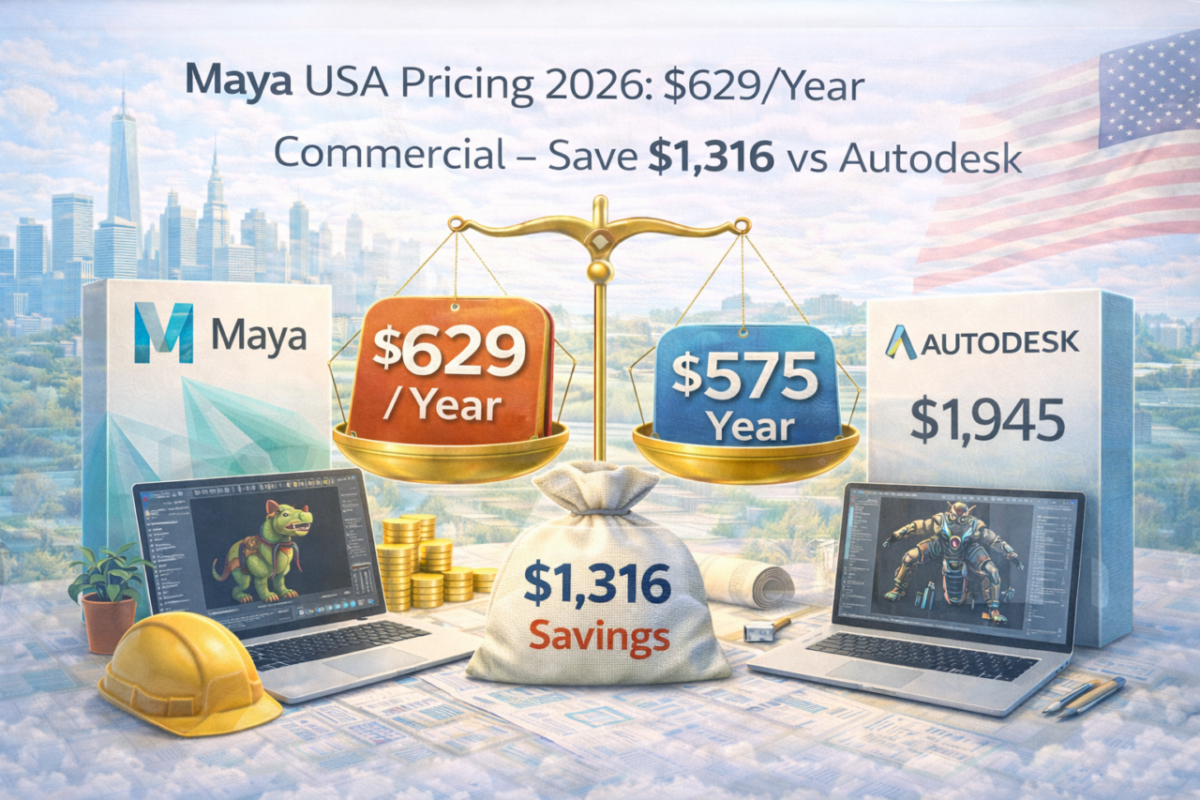
Maya powers Hollywood VFX pipelines, AAA game character rigs, and streaming animation studios. But Autodesk’s $1,945/year official subscription creates sticker shock for small studios, freelance artists, and indie game teams operating on tight margins.
Here’s what most VFX professionals don’t realize: commercial Maya licenses cost $629/year through authorized international channels—$1,316 less than Autodesk’s direct pricing. For a 5-artist animation studio, that’s $6,580 saved annually on identical 3D modeling, rigging, simulation, and Arnold rendering tools.
This guide breaks down Maya’s USA pricing structure, when Maya Indie qualifies vs commercial licenses, and how VFX studios deploy industry-standard animation software without sacrificing features or legitimacy.
Maya Official USA Pricing (March 2026)
Autodesk structures Maya around three subscription tiers:
Monthly: $245/month ($2,940/year if paid monthly)
Annual: $1,945/year (saves $995 vs monthly)
3-Year: $5,545 total ($1,848/year average)
All tiers include Maya’s complete 3D animation toolset: character rigging, keyframe animation, motion graphics, Bifrost simulation, MEL/Python scripting, and integrated Arnold rendering. Updates, cloud collaboration, and Autodesk support come standard.
The pricing increased $70/year in Maya 2026 (up from $1,875 in 2025). For a mid-size VFX studio with 10 Maya seats, Autodesk’s direct pricing costs $19,450/year—a CAD/animation software budget that competes with hiring another junior artist.
Commercial Maya: Same Animation Tools, Lower Cost
Commercial Maya subscriptions at $629/year deliver identical functionality to Autodesk’s $1,945 direct pricing. These licenses originate from authorized Autodesk partners in regions with different pricing structures, then sold to USA-based studios that verify commercial eligibility.
What’s included at $629/year:
- Full Maya 2026 (Windows, macOS, Linux)
- Character rigging and animation tools
- Bifrost simulation (fluids, smoke, ocean)
- Modeling (polygon, NURBS, subdivision)
- Arnold renderer integration (photorealistic output)
- MEL and Python scripting
- Motion graphics workflows
- Cloud collaboration features
- Official Autodesk updates
The license activates through your Autodesk Account—the same authentication system used for $1,945 subscriptions. Arnold renders process identically. MEL scripts execute without modification. FBX exports maintain compatibility.
For a small VFX boutique with 5 artists, the savings compound quickly:
Autodesk Direct: $1,945/year × 5 seats = $9,725/year
Commercial Channels: $629/year × 5 seats = $3,145/year
Annual Savings: $6,580
3-Year Savings: $19,740
That $19,740 funds render farm upgrades, mocap equipment, or marketing that actually brings in client work—not inflated animation software fees.
Maya Indie: When $305/Year Works (And When It Doesn’t)
Autodesk introduced Maya Indie in 2022 for independent creators earning under $100,000 annual revenue. At $305/year, it undercuts both commercial pricing and standard subscriptions significantly.
Maya Indie eligibility:
- Individual artists or studios under $100,000/year revenue
- Same feature set as full Maya
- Watermarked renders (removable in exports)
- Limited to 1 seat per person/studio
Maya Indie limitations:
- Revenue cap strictly enforced ($100,000 USD/year)
- Cannot scale beyond single-seat usage
- Audit risk if revenue grows
For solo freelance animators doing YouTube content, indie game cinematics, or personal projects that generate $30,000-$80,000 annually, Maya Indie at $305/year makes financial sense. The watermark appears during viewport playback but doesn’t embed in final renders or game exports.
For studios with 2+ artists or revenue exceeding $100,000, commercial Maya at $629/year becomes mandatory. A 3-person game studio generating $150,000 revenue needs 3 commercial seats ($1,887/year total)—still $3,948 cheaper than Autodesk’s direct pricing for 3 seats ($5,835/year).
Maya vs 3ds Max: Animation vs Visualization
Autodesk positions Maya for character animation and 3ds Max for visualization/motion graphics. In practice, both handle overlapping workflows, and pricing at commercial rates favors Maya.
Maya advantages:
- Superior character rigging (Advanced Skeleton, HumanIK)
- Better animation toolset (Graph Editor, Time Editor)
- Industry-standard for film/TV/games
- Stronger procedural workflows (Bifrost)
- Cross-platform (Windows, macOS, Linux)
3ds Max advantages:
- Faster modeling for architectural visualization
- Better CAD import (Revit, AutoCAD integration)
- Stronger modifier stack for hard-surface modeling
- Windows-only (deeper OS integration)
Commercial pricing makes Maya the better value:
- Maya commercial: $629/year
- 3ds Max commercial: $629/year (same price)
For VFX studios doing character work, Maya wins outright. For archviz firms rendering buildings, 3ds Max remains preferred. For game studios needing both character animation and environment modeling, Maya’s cross-platform support and rigging tools justify choosing it over 3ds Max.
Real-World Scenario: Indie Game Studio
A 4-person indie game studio in Seattle develops a narrative adventure game with hand-keyed character animation. The team includes 2 animators, 1 technical artist, and a founder handling mocap cleanup.
Year 1 (development):
- 2 Maya Indie seats: $305 × 2 = $610/year
- Revenue under $100,000 (Kickstarter + contracts)
Year 2 (Early Access launch):
- Revenue hits $180,000 (exceeds Indie cap)
- Switch to 3 commercial seats: $629 × 3 = $1,887/year
- Add 1 seat for contractor: 4 × $629 = $2,516/year
Autodesk Direct Alternative: $1,945 × 4 = $7,780/year
Commercial Channels: $629 × 4 = $2,516/year
Savings: $5,264/year
That $5,264 covers:
- Motion capture suit rental (10 shoot days)
- Audio engineer for voice acting
- QA testing budget
- Steam marketing and trailer production
The commercial licenses activate same-day. The team downloads Maya from Autodesk’s site, logs in with existing Autodesk Accounts, and imports all rigged characters from Maya Indie without file conversion. Pipeline scripts (MEL/Python) execute identically.
Deploying Maya: Activation Process
Maya commercial subscriptions activate through standard Autodesk workflows:
Step 1: Purchase commercial license from authorized reseller
Step 2: Receive Autodesk Account assignment via email
Step 3: Log into Autodesk Account (or create new)
Step 4: Download Maya 2026 (Windows, macOS, or Linux)
Step 5: Launch Maya, sign in with Autodesk credentials
The software validates subscription status through Autodesk’s cloud authentication. Arnold renders process on local hardware or cloud render farms. Updates download from Autodesk’s official CDN.
For multi-seat studios, the admin assigns licenses via Autodesk Account admin panel. Each artist logs in with individual Autodesk Account credentials on up to 3 devices (workstation, laptop, home render node). Only one active session per user allowed simultaneously.
Maya supports floating licenses through Autodesk License Manager for larger teams (10+ seats), but most small studios use named-user licensing for simpler administration.
Maya + Arnold: Rendering Without Extra Costs
Maya 2026 includes Arnold integration—no separate renderer purchase required. This matters for VFX studios and game cinematics teams producing photorealistic output.
Arnold handles:
- Path tracing (physically accurate lighting)
- Subsurface scattering (skin, wax, translucent materials)
- Volume rendering (smoke, fog, clouds)
- GPU and CPU rendering
- IPR (interactive preview rendering)
A VFX studio buying standalone Arnold licenses pays $630/year per seat for Arnold Premium. Maya commercial at $629/year bundles Arnold at zero additional cost—a $630/seat saving for rendering-focused pipelines.
For studios rendering with Redshift, V-Ray, or RenderMan, Maya remains compatible. The $629/year commercial price covers modeling/animation/rigging while third-party renderers plug in as needed.
Maya vs Blender: When Free Isn’t Cheaper
Blender offers free 3D animation with active development and growing studio adoption. For solo artists and hobbyists, Blender eliminates software costs entirely.
For commercial studios, Blender introduces hidden costs:
- Pipeline integration: Maya’s industry-standard FBX/Alembic support vs Blender’s evolving compatibility
- Training time: Artists trained on Maya (80%+ of industry) vs Blender onboarding
- Client deliverables: Studios expect Maya/3ds Max files for asset handoffs
- Plugin ecosystem: Maya’s mature scripting/plugin library vs Blender’s developing ecosystem
A VFX boutique hiring 3 Maya-experienced artists can onboard them in 1-2 days. Hiring 3 Blender artists requires either rare specialized talent or 2-4 weeks retraining from Maya workflows. At $100/hour blended rate, that’s $19,200 in lost billable time (4 weeks × 3 artists × 40 hours).
Maya commercial at $1,887/year (3 seats) costs less than the Blender training overhead—while maintaining industry-standard deliverables.
Payment Methods & Purchase Process
Authorized Maya commercial resellers typically accept:
- Credit/debit cards (Visa, Mastercard, Amex)
- Wire transfer (bulk orders, studio agreements)
- Apple Pay, Google Pay, Link
- Cryptocurrency (BTC, USDT, ETH—select vendors)
License assignments process within 24-48 hours for credit card purchases. Autodesk Account emails arrive typically within 1-2 business days. Rush activation (same-day) available for urgent production deadlines.
Confirm the reseller provides:
- Email confirmation with license details
- Autodesk Account assignment (not product key)
- Commercial license type specification
- Refund policy (typically 30 days)
Avoid vendors advertising “lifetime” Maya licenses or suspiciously cheap subscriptions under $300. Autodesk discontinued Maya perpetual licensing in 2016. Anything marketed as lifetime is fraudulent, expired, or misrepresented educational access.
When to Buy: Timing Your Maya Purchase
Autodesk adjusts Maya pricing annually—typically March/April aligned with new version releases. Commercial reseller pricing fluctuates less dramatically but responds to currency exchange rates.
Best times to buy:
- Q1 (January-March): Studios allocate annual software budgets
- After Autodesk increases: Lock in current rates before resellers adjust
- Project starts: Avoid mid-production license scrambles
- Volume purchases: 5+ seats may qualify for additional discounts
Avoid if possible:
- Last-minute purchases during delivery deadlines (limits vendor selection)
- Relying on trial versions for client work (watermarked output)
Most Maya commercial subscriptions auto-renew annually. Set calendar reminders 30 days before renewal to compare pricing, evaluate seat counts, and switch vendors if better rates emerge.
Maya Legal Considerations for USA Studios
VFX studios and game teams running commercial Maya should:
Maintain documentation: Purchase invoice, Autodesk Account assignment email
Match license type to revenue: Commercial for studios >$100,000/year
Avoid license sharing: Each artist needs individual named license
Respond to audits promptly: BSA targets creative studios
The Business Software Alliance (BSA) audits VFX and game studios regularly—often triggered by competitor complaints or employee reports. Running Maya Indie on $200,000 revenue creates liability that commercial licensing eliminates.
BSA settlements for unlicensed software start at $20,000 per violation and scale based on studio revenue. A 5-person studio caught using cracked Maya faces $100,000+ settlements plus legal fees.
Commercial Maya at $3,145/year (5 seats) costs less than one BSA settlement—and eliminates audit risk entirely.
Maya USA Pricing: 2026 Summary
Autodesk’s $1,945/year official Maya pricing serves large studios with enterprise agreements and centralized purchasing departments. It’s defensible for teams prioritizing single-vendor support simplicity.
But VFX boutiques, indie game studios, and freelance animation teams operating on project-based budgets can’t ignore $1,316/year per seat savings. Commercial licenses at $629/year deliver identical character rigging, simulation, rendering, and scripting tools through official Autodesk Account activation.
For a 5-artist studio, that’s $6,580 saved annually—enough for render farm upgrades, mocap equipment, or marketing spend that generates actual client revenue.
Maya remains the industry standard for 3D character animation in USA film, TV, and game production. At commercial pricing, it’s also financially accessible for independent creators.
Ready to deploy Maya at $629/year commercial pricing?
Get Maya 2026 Commercial – $629/Year →
Need architectural visualization instead?
3ds Max 2026 Commercial – $629/Year →
Building game cinematics?
Maya includes Arnold rendering—no separate renderer purchase required.